Last updated: February 2026 by Jaylen Torres, Curly Hair Editor (IAT-certified trichologist)
I asked for a curly hair fade at 16, sat down, said “fade with the curls on top,” and walked out looking like someone placed a broccoli floret on a bowling ball. The sides were too short, the top was uneven, and my 3B curls had that confused look where half of them just gave up. That haircut haunted me for three weeks.
The problem was not the barber. The problem was that neither of us knew how to talk about a curly hair fade in a way that accounts for how curls actually behave. Most fade reference photos show straight hair. Most barber training focuses on straight-hair blending. So when a guy with 3A or 3C curls says “give me a fade,” there is a translation gap that often ends badly.
This guide covers 10 curly fade styles that work across curl types 2C through 4A, how to ask your barber for each one, and the products that keep the curly top defined. If you only read one section, jump to the comparison table.
Why Your Curl Type Changes Everything About a Fade
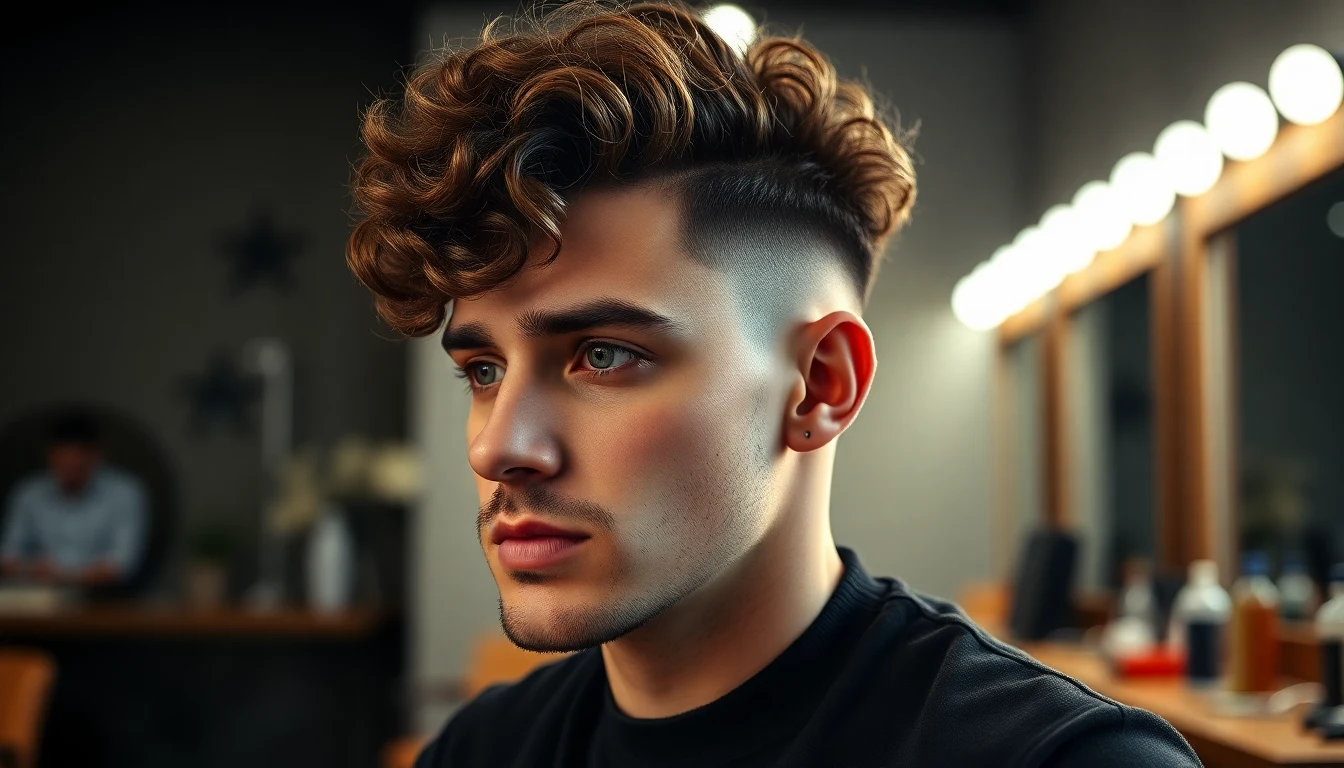
The same fade looks like a completely different haircut on different curl types. A mid fade on 3A curls (loose, springy, sidewalk-chalk diameter) creates a soft, relaxed contrast. That same mid fade on 4A coils (tight S-shaped when stretched) creates dramatic contrast with a sharper fade line.
Three things drive this difference:
- Curl shrinkage. 3A curls shrink about 25% from wet to dry. 3C curls shrink 40%+. 4A coils can shrink 50%+. If your barber cuts the top wet, they are guessing at your final length. That guess is usually wrong.
- Volume direction. Looser curls (2C, 3A) fall outward and downward. Tighter curls (3C, 4A) build upward. This changes which fade height looks balanced on your head.
- Blending difficulty. The transition from curly top to faded sides is harder with tighter curl types. A skilled barber uses clipper-over-comb and texturizing shears, but it takes more time with 3C and 4A curls than with 3A.
Bottom line: do not pick a fade based only on a photo. Consider your curl type. I will tell you which curls work best with each style below.
10 Curly Hair Fade Styles That Actually Work
1. Low Fade With Curly Top
The low fade blends about half an inch above the ear. On curly hair, it is the most conservative option: maximum curl volume on top, subtle transition, and you can stretch three to four weeks between barber visits.
Best curl types: 2C, 3A, 3B. Looser curls pair well with the understated blend.
Tell your barber: “Low fade starting just above my ear. Keep the top at [X inches] when dry. Gradual blend.”
Key product: A lightweight curl enhancing cream keeps definition without weighing down curls near the fade line.
2. Mid Fade Curly
The mid fade starts at the temple line. This is the most popular type of fade with curly hair because it creates visible contrast without going extreme. For most guys, this is the “can’t go wrong” choice.
Best curl types: 3A, 3B, 3C. The curl volume sits right above the fade line, creating balanced proportions.
Tell your barber: “Mid fade at my temples. I want contrast between the curls and the sides, but keep the blend smooth. Cut the top dry.”
Key product: Medium-hold gel scrunched into damp curls defines the top against the clean sides.
3. High Fade Curly
The high fade starts near the crown, leaving a concentrated curl cluster on very short sides. This is the most dramatic contrast before mohawk territory. It elongates round faces and highlights your curl pattern, but it needs touch-ups every two weeks.
Best curl types: 3B, 3C, 4A. Tighter curls create strong visual impact. Looser 3A curls tend to flop over at this height, blurring the contrast.
Tell your barber: “High fade, about two fingers above my temples. Strong contrast. Top stays full, sides down to a one or zero guard.”
Key product: A medium-to-strong hold gel. Apply to soaking wet hair, scrunch, diffuse, then scrunch out any crunch once dry.
4. Skin Fade Curly
The skin fade (bald fade) takes the shortest point to bare skin. On curly hair, this creates the sharpest contrast possible. It can be positioned low, mid, or high. The catch: you will see regrowth within a week, so budget for visits every 10 to 14 days.
Best curl types: 3B, 3C, 4A. Tighter curls transition more naturally from skin. Loose 2C waves against bare skin can look disconnected. If your coils are tighter than 4A, check Darius Washington’s Black men’s hairstyles guide for 4B-4C coverage.
Tell your barber: “Skin fade blended up to where my curls start. Zero visible line between skin and curl. Take your time on the transition.”
Key product: Leave-in conditioner. Skin fades draw all attention to the top, so dry or frizzy curls are impossible to hide.
5. Taper Fade Curly
The taper fade is the most gradual option. It reduces length slowly, ending above the natural hairline with hair still visible. On curly hair, this creates a polished look that does not scream “fresh from the barbershop.” It grows out gracefully and needs touch-ups only once a month.
Best curl types: 2C, 3A, 3B. The gradual transition matches softer textures. On 3C or 4A curls, a taper can look too subtle.
Tell your barber: “Taper fade. Sides shorter but no skin showing. Gradual blend. Natural look.”
Key product: Light curl cream on wash days. Low-maintenance cut, low-maintenance routine.
6. Drop Fade Curly
The drop fade line “drops” lower behind the ear than at the temples, following the natural curve of your skull instead of cutting across in a straight line. This is one of the best curly fade styles because curls naturally fall in a rounded shape, and the curved fade mirrors that.
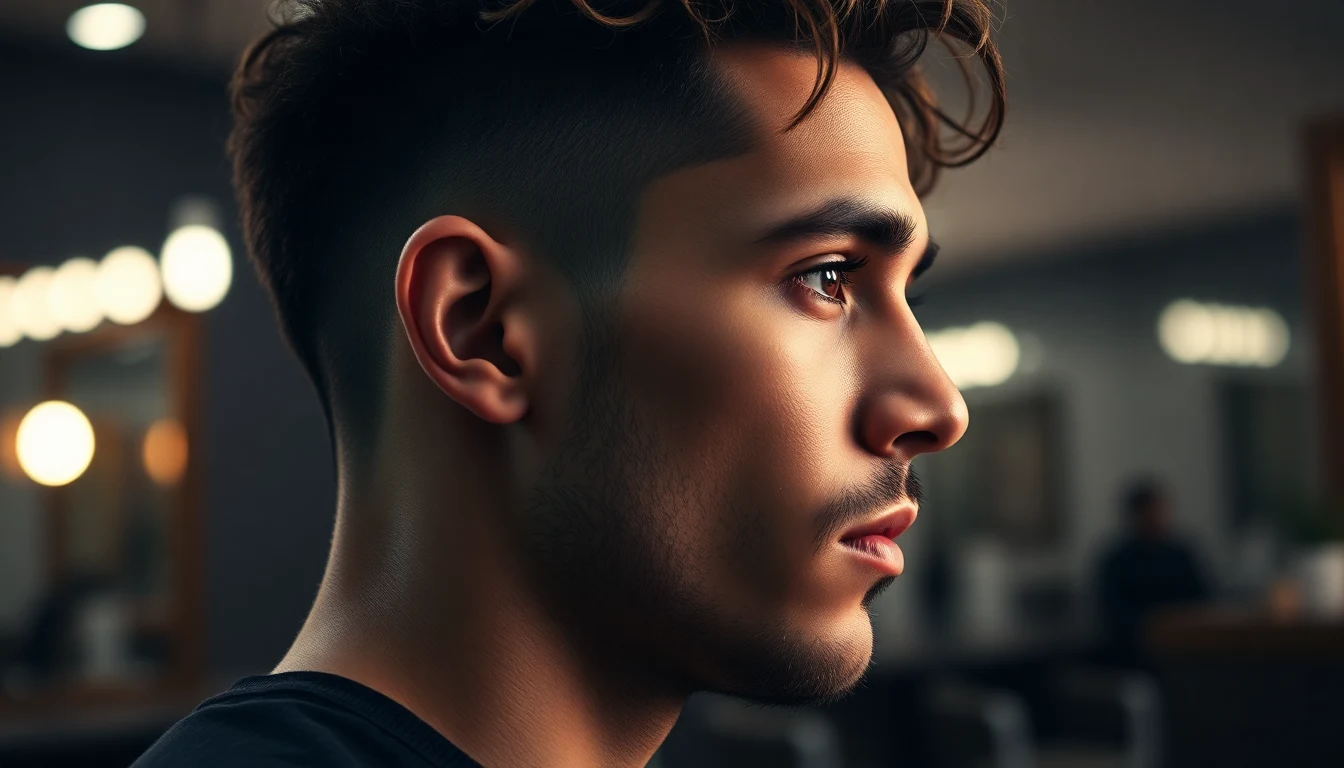
Best curl types: 3A, 3B, 3C. The dropping line complements the round silhouette of curly hair beautifully.
Tell your barber: “Drop fade. Fade line follows the curve of my head, dropping lower behind my ear. Mid-height at the temples.”
Key product: A curl activator cream defines curls around the crown and nape where the drop line meets your hair.
7. Burst Fade Curly
The burst fade radiates outward from behind the ear in a semicircular pattern. It is one of the more creative shapes and naturally complements textured hair. Eye-catching from the back and sides, normal from the front.
Best curl types: 3B, 3C, 4A. Tighter curls provide the density that makes the burst pattern pop. Loose 2C-3A curls drape over the pattern, hiding it.
Tell your barber: “Burst fade around the ears. Curls stay full on top, fade radiates outward. No straight lines.”
Key product: Medium-hold gel to keep curls upright and defined, preventing them from falling over the burst pattern.
8. Temp Fade Curly
The temp fade (temple fade) only fades the temple and sideburn area, leaving the rest of the sides longer. Think of it as a fade accent, not a full fade. Perfect for guys growing out their curls who want to stay neat during the awkward phase.
Best curl types: 2C, 3A, 3B. Works when you want to keep side length and just clean up the edges.
Tell your barber: “Temple fade only. Clean up sideburns and temples, leave the rest of the sides as is.”
Key product: Whatever you already use. The temp fade does not change your styling approach.
9. Curly Fringe Fade
A mid or high fade on the sides with curls left longer in front, creating a fringe (bangs) that falls over the forehead. If you have seen the Edgar haircut and want something similar with natural curls instead of a blunt line, this is it.
Best curl types: 2C, 3A, 3B. Looser curls fall forward naturally. Tighter 3C-4A curls coil upward, making the fringe difficult without heat styling.
Tell your barber: “Fade the sides, leave the front longer so my curls fall over my forehead. Curly fringe, not a flat-cut bang.”
Key product: Lightweight mousse. Heavy creams cause the fringe to clump and lose the airy, falling effect.
10. Curly Mohawk Fade
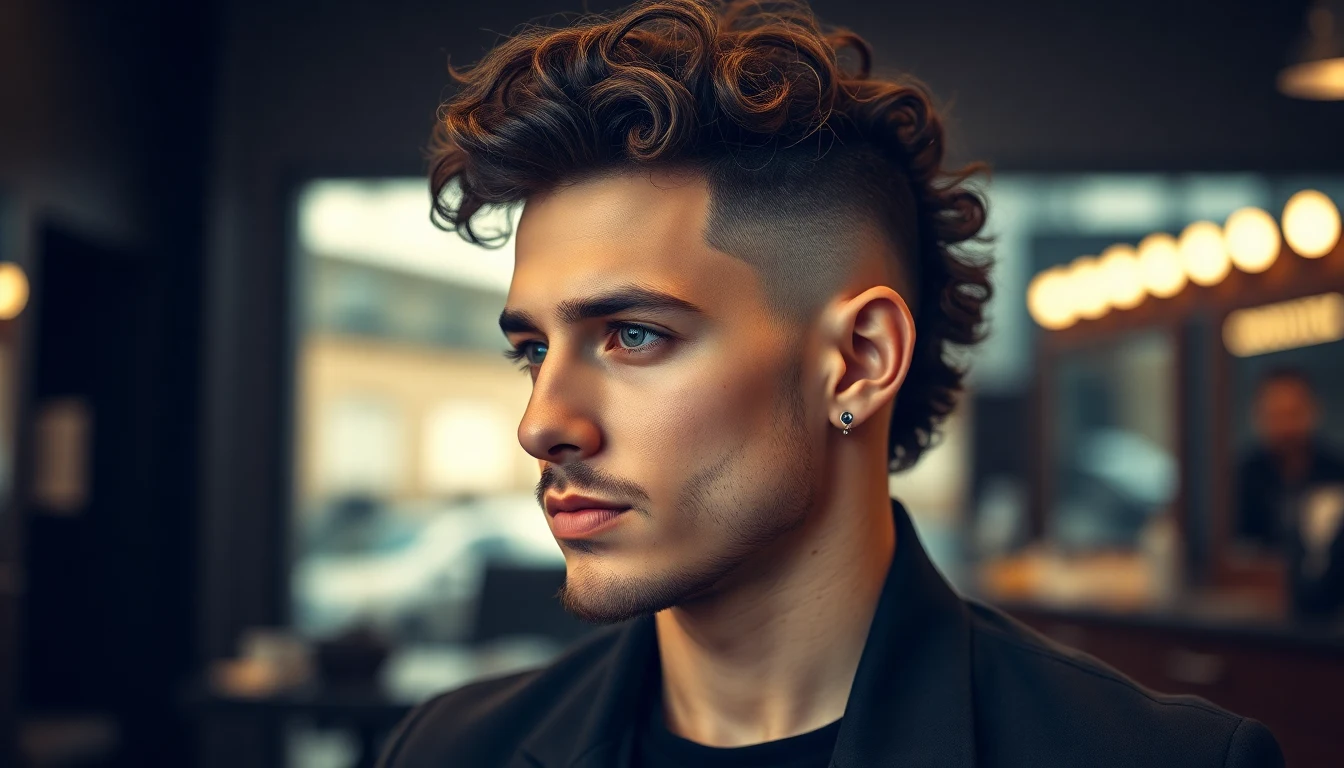
Sides down to a high or skin fade. A strip of curly volume from hairline to crown. This is the boldest curly fade style. Unlike a traditional mohawk with spiked straight hair, the curly version uses your natural texture as the “hawk,” giving it a rounded, organic shape.
Best curl types: 3B, 3C, 4A. You need curl density and upward spring to hold the shape. Loose 2C-3A curls flop to the sides.
Tell your barber: “Curly mohawk. Skin fade the sides. Leave a strip about three to four fingers wide on top. Do not thin the curls.”
Key product: Strong-hold gel. Apply to wet hair, diffuse upward, seal with a light holding spray.
Curly Fade Comparison Table
| Style | Best Curl Types | Fade Height | Maintenance | Best For |
|---|---|---|---|---|
| Low Fade | 2C, 3A, 3B | Above ear | Low (3-4 wks) | Conservative, first fades |
| Mid Fade | 3A, 3B, 3C | Temple | Medium (2-3 wks) | Most versatile |
| High Fade | 3B, 3C, 4A | Near crown | High (2 wks) | Bold contrast, round faces |
| Skin Fade | 3B, 3C, 4A | Any (to skin) | High (10-14 days) | Sharpest contrast |
| Taper Fade | 2C, 3A, 3B | Gradual (no skin) | Low (3-4 wks) | Professional, natural |
| Drop Fade | 3A, 3B, 3C | Drops behind ear | Medium (2-3 wks) | Natural silhouette |
| Burst Fade | 3B, 3C, 4A | Radiates from ear | Medium (2-3 wks) | Creative, eye-catching |
| Temp Fade | 2C, 3A, 3B | Temples only | Very Low (4-6 wks) | Minimal, growing out |
| Curly Fringe | 2C, 3A, 3B | Mid or High | Medium (2-3 wks) | Fashion-forward |
| Curly Mohawk | 3B, 3C, 4A | High / Skin | High (10-14 days) | Statement cut |
How to Talk to Your Barber About a Curly Fade
Most barbers know how to fade. Many know how to cut curls. But the intersection is a specific skill set, and the communication gap is where bad curly fades happen. Here is your playbook.
Bring a Reference Photo of YOUR Curl Type
Not a model with straight hair. Not someone whose curls are two types away from yours. Find a photo of someone with a similar curl pattern and density wearing the fade you want. If you cannot find an exact match, bring two photos: one for the fade shape, one for how you want the curly top to look.
Ask for a Dry Cut on Top
This is the most important sentence you will say: “Can you cut the top dry?” Curly hair shrinks 25-50% from wet to dry. A barber cutting wet curls is guessing at your finished length. Let them clipper the fade first, then cut the curly top dry.
Specify Length in Inches, Not Guard Numbers
Guard numbers work for the sides. For the curly top, always talk in inches of dry curl length. “I want three inches of curl when it’s dry” is clear. “Leave it long on top” is not.
Volunteer Your Shrinkage Percentage
Most barbers will not ask, so tell them: “My curls shrink about 40%, so we need to leave more than it looks.” That one sentence can save an inch of curl you wanted to keep.
Ask About the Transition Zone
The spot where curly top meets faded sides is the hardest part. Ask: “How will you blend the transition?” A barber who answers confidently (clipper-over-comb, texturizing shears, point cutting) has done this before. One who hesitates might not be the right fit for curly fades. When it comes to curly hair fade, technique matters most.
Products for Maintaining the Curly Top
The fade is your barber’s job. The curly top is yours. Nada mas, nada menos.
The 3-Product System
Three products, max. More than that creates buildup and wastes money.
1. Leave-in conditioner. Apply to damp hair after washing. This prevents frizz and keeps curls hydrated. Go lightweight for 2C-3B; slightly heavier cream-based for 3C-4A.
2. Curl defining cream or gel. Goes on top of the leave-in while damp. A curl cream gives softer hold; gel gives more definition but can crunch (scrunch it out once dry). I use cream daily and gel when I want the curls to really pop against the fade.
3. Light oil (optional). A few drops of argan oil over dried curls adds shine and seals moisture. Skip in humid climates. I live in Miami, so this is a winter-only move for me.
Diffuser Technique
A diffuser is the best tool for styling a curly top fade. Apply products to soaking wet hair, set to medium heat and low speed, cup curls in the diffuser bowl and hold 20-30 seconds per section (do not move it around), dry to 80%, air-dry the rest. Scrunch out gel crunch with a drop of oil on your palms. The extra volume from diffusing makes the fade contrast sharper.
What to Avoid
- Heavy butters and thick pomades. Designed for 4B-4C textures or slicking straight hair. On 2C-3C curls, they flatten your pattern.
- Terry cloth towels. Cause frizz. Use microfiber or an old T-shirt. Scrunch, never rub.
- Brushing dry curls. I did this until 17 and looked like a dandelion. Detangle in the shower with conditioner only.
- Daily washing. Curly hair does not need it. Two to three times per week is plenty. On off days, just wet, condition, restyle.
When Your Curl Pattern Is Not Uniform
Here is something nobody mentions in fade guides: many guys have multiple curl types on one head. My crown is 3C, my sides lean 3B, and my front is closer to 3A. Three textures, one head. Asi es la vida. This is extremely common in mixed-texture hair.
How to handle it with a fade:
- Choose your fade based on your dominant curl type (usually the crown area).
- Tell your barber. “My front is looser than my crown, so it will hang differently.” This helps them shape the top for the variation instead of cutting to one length.
- Use different product amounts by zone. Tighter zones need more moisture. Looser zones need less product. I use a full pump of cream on my crown, half a pump on the front.
- Accept that uniformity is not the goal. Mixed-texture curls will not look uniform. That is texture, not a flaw. A good barber cuts to celebrate the variation.
For a full routine built around non-uniform curls, I am working on a complete men’s curly hair routine guide.
Frequently Asked Questions
What is the best fade for curly hair?
The mid fade is the most versatile option, working across 2C through 4A curls and nearly every face shape. The drop fade is a close second because its curved line mirrors how curly hair naturally falls. Your best pick depends on your curl type, contrast preference, and barber visit budget.
Should curly hair fades be cut wet or dry?
Cut the top dry. Curly hair shrinks 25-50% from wet to dry, so cutting wet usually means too much length removed. The sides can be clippered wet or dry. Ask your barber to do the fade first, then shape the curly top dry.
How often should I get a curly hair fade touched up?
Every two to three weeks for most styles. Skin fades and high fades need attention every 10 to 14 days. Low and taper fades stretch to three or four weeks. Tighter curls (3C, 4A) hide regrowth better than looser curls (2C, 3A).
Can I get a curly fade with loose or wavy hair (2C)?
Absolutely. A taper fade or low fade matches 2C’s softer texture. Use a gradual blend rather than an abrupt skin fade. A little mousse on top adds definition so the contrast between sides and top stays visible.
What products maintain the curly top?
Three products max: leave-in conditioner, curl cream or gel, and optionally a light oil. For 2C-3B, keep everything lightweight. For 3C-4A, a curl activator cream provides moisture and definition without crunch. Check our upcoming curly hair products guide for full reviews.
Your Next Move
- Your curl type determines your best fades. Looser curls (2C, 3A) pair with low and taper fades. Tighter curls (3C, 4A) pair with high, skin, and burst fades. 3B curls can go almost anywhere.
- Always ask for a dry cut on top. This prevents the most common curly fade mistake.
- Bring a reference photo of someone with your actual curl type.
- Three products for the top: leave-in, styler, optional oil.
- If unsure, start with a mid fade. Safest, most versatile.
Your curls are not a problem to solve. They are the feature. The fade is the frame. Pick a frame that fits, communicate clearly with your barber, and you will not leave the chair disappointed again.
Want a full routine? Check the men’s curly hair routine guide. Different texture entirely? Our Asian hairstyles guide covers straight, thick hair, and the complete fades guide breaks down every fade type across all textures.
Tu pelo, tus reglas. Go get the cut.
Frequently Asked Questions
What’s the difference between a curly hair fade and a regular fade?
A curly hair fade is specifically designed to work with your curl pattern by leaving enough length on top to define your curls while fading the sides short. Regular fades often don’t account for how curls shrink and expand, which can make your fade look uneven or messy as your curls dry and settle.
Which curl types work best with a curly hair fade?
Curly hair fades work well with 2C to 4A curl types, with 3A to 3C curls showing the most defined results. If you have looser waves (2C) or tighter coils (4A+), your barber may need to adjust the fade height and taper to complement your specific curl pattern.
How do I ask my barber for the right fade on curly hair?
Show your barber the specific fade style you want (low, mid, high, or skin fade) and tell them your curl type if you know it (for example, 3B or 3C curls). Ask them to cut your hair while it’s curly and dry, not wet or straight, so they can see how your curls will actually look after the fade is complete.
What products should I use to maintain my curly hair fade?
Use a curl-defining cream or gel to enhance your curl pattern on top, and keep a line-up tool or edge moisturizer for maintaining sharp lines around your fade. Regular moisturizing is key since fades can expose more scalp, so consider a lightweight oil or scalp serum to prevent dryness between cuts.