Last updated: March 2026 by Marcus Chen-Williams, Founder & Editor
Black men’s hair requires specific techniques that generic haircutting guides almost never cover. The curl pattern, density, growth direction, and shrinkage factor of coily and 4C hair types create unique challenges and opportunities when cutting at home.
This guide covers everything you need to cut Black men’s hair at home: the right tools, how to work with (not against) the natural texture, fade techniques for coily hair, lineup precision, and finishing details that make the difference between a home haircut and a barbershop-quality result. For expert guidance on this topic, consult the American Academy of Dermatology’s Black hair care guide.
If you are new to cutting hair entirely, start with our complete home haircutting guide for general fundamentals, then come back here for texture-specific techniques.
Understanding Black Hair Textures
Not all Black hair is the same. The Andre Walker hair typing system classifies textures from Type 3 (curly) through Type 4 (coily), with subcategories A, B, and C representing tightness of curl pattern.

| Type | Pattern | Cutting Considerations |
|---|---|---|
| 3A-3B | Loose to medium curls | More visible curl definition. Cut dry. Moderate shrinkage (15-25%). |
| 3C | Tight corkscrew curls | Dense curl pattern. Significant shrinkage (25-35%). Requires patience on blending. |
| 4A | Tight S-pattern coils | High density. Cut dry. Shrinkage up to 40%. Works well with fades. |
| 4B | Z-pattern coils | Very dense, sharp angles in curl. Clippers may need multiple passes. Excellent for structured fades. |
| 4C | Tightest coil, minimal definition | Maximum density and shrinkage (up to 75%). Requires strong clippers, patience, and dry cutting. |
The practical takeaway: the tighter the curl, the more shrinkage you deal with, the more passes your clippers need, and the more forgiving the blend zone becomes (because the curl pattern naturally softens transitions).
Essential Tools for Cutting Black Men’s Hair
Standard consumer clippers often lack the motor power to move cleanly through dense coily hair. This is where tool selection matters most.
Clippers: What to Look For
- Motor type: Rotary or pivot motor over magnetic. Rotary motors maintain power through thick hair without slowing down.
- Adjustable taper lever: Essential for fades. Allows you to adjust blade length without changing guards.
- Blade quality: Carbon steel or ceramic blades. Stainless steel dulls faster on coily textures.
- Cordless preferred: The freedom to move around the head without cord tension is significant when working with textured hair.
Trimmers: Non-Negotiable
For Black men’s hair, the trimmer is not optional. Lineups, edge detailing, and temple fades require a precision tool that clippers cannot match.
- T-blade shape: Gives you visibility of the cutting line
- Zero-gap capability: Adjusting the blade to cut as close as possible without nicking skin
- Clean lines: The trimmer defines your hairline, and the hairline defines the entire cut’s perceived quality
Additional Tools
- Wave brush or soft bristle brush: For brushing hair to reveal the true pattern before cutting
- Spray bottle with water + leave-in conditioner: For moisturizing between sections (not soaking)
- White grease pencil: For outlining your desired lineup before committing with the trimmer
- Blade wash or disinfectant: Coily hair can clog blades faster; clean between sections
The Golden Rule: Cut Dry
This is the single most important principle for cutting coily hair. Wet 4C hair can stretch to twice its dry length. If you cut to the length you want while the hair is wet, it will shrink dramatically once dry and you will end up significantly shorter than intended.
The exception is very close clipper work (guards #1 or shorter), where shrinkage is negligible because the hair is too short to curl.

Before cutting, brush the hair out with a soft brush to reveal the natural pattern and identify any uneven areas. This is your true baseline.
Step-by-Step: The Temple Fade on 4C Hair
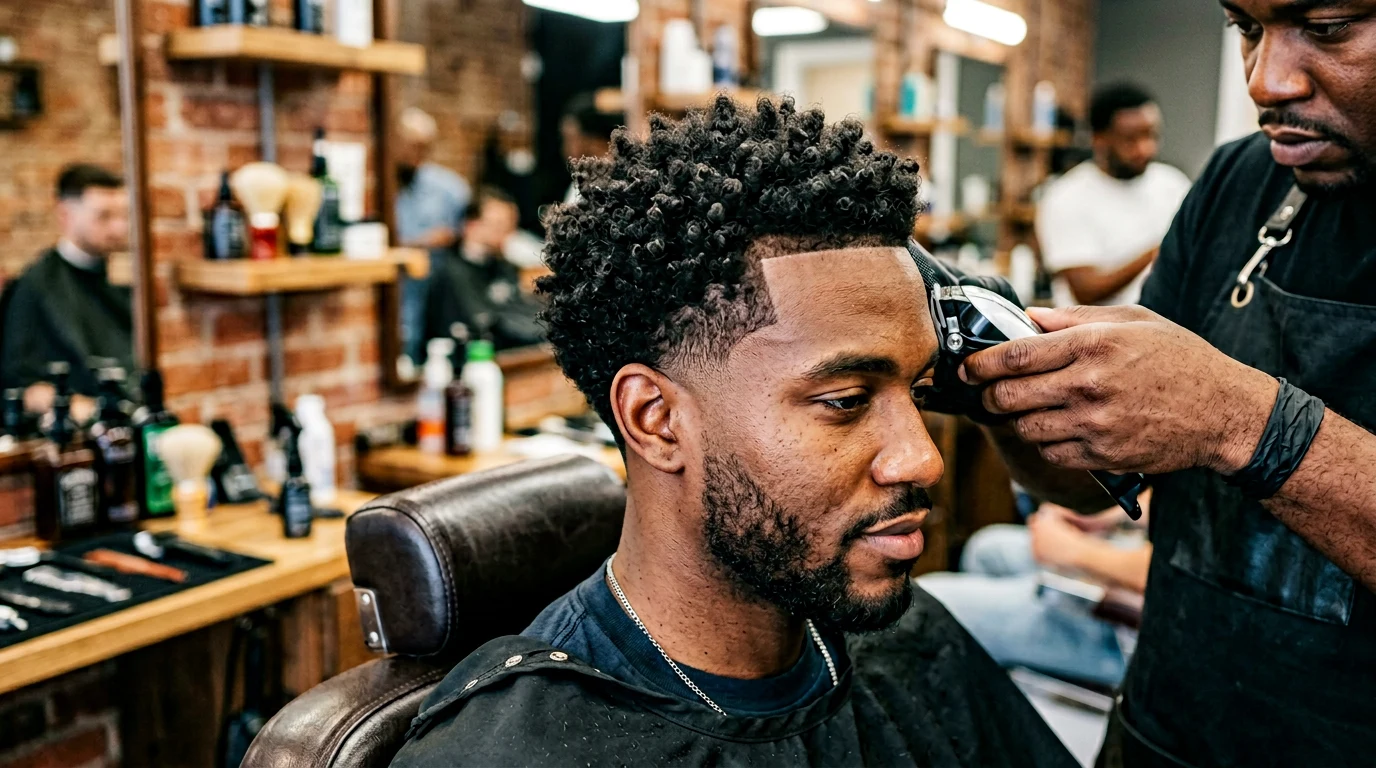
The temple fade (also called a temp fade or Brooklyn fade) is one of the most popular and versatile cuts for Black men. It fades the hair around the temples and ears while keeping length on top.
Step 1: Define the Fade Line
Decide where the fade transitions from short to long. For a temple fade, this line curves from the front temple area down and around the ear to the back. Use a #1 or #1.5 guard to establish the bottom of the fade zone around the perimeter.
Step 2: Create the Gradient
Work upward from the shortest point using progressively longer guards. On 4C hair, the curl pattern naturally softens the blend between guard lengths, which is an advantage. Use the clipper’s taper lever in the half-open position to create intermediate lengths between guards.
Step 3: Blend the Crown
The transition from the faded sides to the top is the critical zone. Use a “scoop and flick” motion: guide the clipper into the transition zone and flick outward. On coily hair, this motion catches just the tips and creates a natural taper rather than a hard line.
Step 4: Shape the Top
The top can be left natural, picked out for height, twisted, or cut with a longer guard for a uniform length. For a classic high-top fade, use the pick to stretch hair to desired height and trim across the top with clippers or scissors.
Step 5: The Lineup
The lineup is what makes Black men’s haircuts look sharp. Using the T-blade trimmer:
- Start at the center of the forehead and work outward
- Follow the natural hairline, straightening and cleaning as you go
- Use short, controlled strokes (do not drag the trimmer in long lines)
- The temples should form a clean angle, not a curve
- Check symmetry by standing directly in front and using a mirror for both sides
If lineups make you nervous, outline your desired shape with a white grease pencil first. This gives you a visual guide to follow and dramatically reduces the chance of going too far.
360 Waves Maintenance Between Cuts
If you or the person you are cutting maintains 360 waves, the cutting approach changes. Waves require a specific length (usually #1 to #2 guard on the WaveEnforcer method) cut with the grain of the wave pattern.
- Always cut with the wave direction, not against it
- Use a guard one size longer than your target, then adjust down
- Do not go against the grain on waves (it disrupts the pattern)
- The lineup is the only area where you break the wave pattern with the trimmer
- Wolfing period (growing waves out between cuts) typically lasts 4-6 weeks
Skin Fades on Coily Hair
A skin fade on 4C hair is one of the sharpest looks in men’s grooming. The contrast between bare skin and the dense coil pattern creates a striking gradient. Here is the approach:

- Start with no guard (or foil shaver) at the very bottom of the fade zone
- Open the clipper lever to its longest setting and work upward from the bare skin, creating the first blend zone
- Close the lever gradually as you move higher, increasing the cut length
- Switch to a #0.5 guard, then #1, then #1.5, blending each step upward
- The coily texture acts as a natural diffuser, making the gradient smoother than it would appear on straight hair
This technique takes practice. If you are new to fading, start with a standard fade (guard-to-guard stepping) before attempting skin fades. The Home Haircutting Mastery course covers fade progression in detail, from basic blending through advanced skin fades, with video demonstrations that are easier to follow than written descriptions for this technique.
Post-Cut Care for Black Hair
A clean cut on coily hair only stays sharp with proper maintenance.
- Moisturize immediately after cutting: The cut exposes fresh ends that dry out quickly. Apply a leave-in conditioner or natural oil (jojoba, argan, or coconut).
- Lineup touch-ups: Every 5-7 days with the trimmer to keep the hairline sharp.
- Night protection: A silk or satin durag or bonnet preserves the cut shape and prevents friction damage while sleeping.
- Moisturize daily: LOC method (liquid, oil, cream) keeps coily hair healthy between cuts.
- Do not wash daily: Coily hair benefits from washing every 5-7 days. Over-washing strips natural oils and dries out the texture.
Frequently Asked Questions
What clippers are best for cutting Black men’s hair at home?
Look for clippers with a powerful rotary or pivot motor that can handle thick, coily hair without snagging. Professional-grade options with adjustable taper levers are essential for fades on 4C textures. Cordless models give you better maneuverability around the head. T-blade trimmers are critical for clean lineups.
Should I cut Black men’s hair wet or dry?
Always cut coily and 4C hair dry unless you are doing a very close buzz cut. Wet curly hair stretches and appears longer. When it dries and shrinks back, the cut will be significantly shorter than intended. Cutting dry gives you an accurate view of the true length and curl pattern.
How do I get a clean lineup on coily hair?
Use a T-blade trimmer with zero-gap blades. Define the natural hairline first by trimming along its existing shape, then carefully straighten any uneven edges. Work in short, controlled strokes. For the temples, follow the natural contour of the head. Use a white pencil or grease pencil to outline your desired shape before cutting if you are a beginner.
How do I maintain a fade between full haircuts?
Use a trimmer to clean up the neckline and around the ears every 5 to 7 days. The lineup can be touched up weekly with a T-blade. The fade itself can go 2 to 3 weeks between full cuts depending on hair growth speed. Moisturize daily to keep the remaining hair healthy and defined.
Can I do a skin fade on 4C hair at home?
Yes, though skin fades on 4C hair require practice and the right technique. The tight curl pattern makes blending easier in some ways because the gradual curl adds natural texture to the transition. Use the clipper lever to adjust blade height and work in small sections. Start with a low fade before attempting a high skin fade.
The Bottom Line
Cutting Black men’s hair at home is absolutely achievable with the right tools, the right technique, and an understanding of how coily textures behave. The key differences from general haircutting: always cut dry, invest in a powerful clipper and quality trimmer, master the lineup, and moisturize after every cut. Start with a basic temple fade, build your confidence, and the more advanced techniques will follow naturally.