Last updated: March 2026 by Marcus Chen-Williams, Founder & Editor
Asian men’s hair presents a specific set of challenges that rarely get addressed in general haircutting guides. The hair is typically coarse, thick, perfectly straight, and grows at an angle that makes it stand upright when cut short. These are not problems to solve. They are characteristics to work with.
This guide covers the techniques specific to cutting East Asian, Southeast Asian, and South Asian hair types at home. From managing thickness to executing a clean two-block cut to preventing the dreaded “sides sticking out” issue, everything here is designed for this hair type. For expert guidance on this topic, consult Healthline’s dermatologist-reviewed hair care guide.
If you need general haircutting fundamentals first, our complete home haircutting guide covers tool setup, guard lengths, and basic technique.
Understanding Asian Hair Structure
Asian hair strands have the largest cross-section diameter of any ethnicity, averaging 80-120 micrometers compared to 60-90 for Caucasian hair and 60-80 for African hair. This gives each strand significant rigidity.
| Characteristic | Impact on Cutting |
|---|---|
| Thick individual strands | Each strand is strong and visible. Imprecise cuts show more. |
| Round follicle shape | Hair grows straight, perpendicular to scalp. Stands up when short. |
| High density (follicles per cm²) | More hair per area means more resistance for clippers. |
| Strong growth direction | Cowlicks and growth whorls are more pronounced and harder to overcome. |
| Slower curl relaxation | Unlike wavy hair, Asian hair maintains its straight shape, making uneven areas obvious. |
The “Sticking Up” Problem and How to Manage It
The most common complaint from Asian men cutting at home: “My sides stick straight out.” This happens because thick, straight hair lacks the flexibility to lay flat when cut below a certain length.

Solutions:
- Keep sides longer: A #3 guard or above gives enough weight for the hair to lay down. Below #3, sticking becomes likely.
- Taper instead of fade: A gradual taper keeps more length on the sides than a traditional fade, avoiding the porcupine zone. Our soft taper for Asian men guide covers this in detail.
- Use texturizing: Thinning shears on the sides reduce bulk without shortening length. Less bulk means less outward pressure.
- Style with product: A strong-hold pomade or wax can tame shorter sides. Apply to damp hair and press flat while drying.
- Disconnect (two-block): If you want very short sides, fully commit to a disconnected style rather than trying to blend. The contrast is intentional.
Essential Tools
The same general toolkit applies, with a few additions specific to thick straight hair:
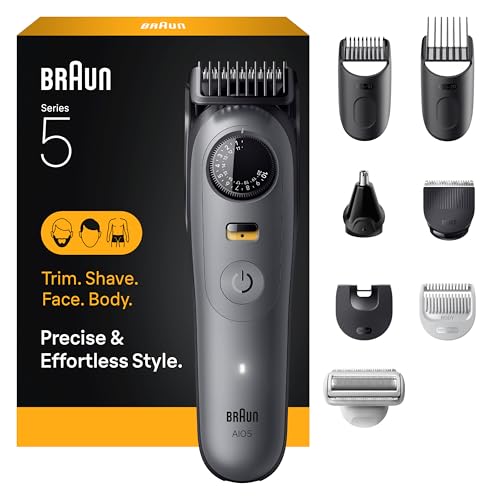
- Powerful clippers: Same requirement as Latino hair. Thick hair demands rotary motors that do not bog down.
- Thinning shears (essential): Unlike other textures where thinning is optional, Asian hair almost always benefits from removing bulk. A 30-tooth thinning shear is a good starting point.
- Texturizing scissors: More aggressive than thinning shears. Used for creating movement in the top sections.
- Flat iron (optional): For styles that require the hair to lay in a specific direction. A quick pass tames stubborn growth directions.
- Blow dryer: Training thick Asian hair into a style almost always requires heat styling. A blow dryer with a concentrator nozzle directs airflow for shaping.
![CRVFT Gel Pomade 4oz | High Shine/Medium Hold | Water Based/Water Soluble | Ideal For Short/Medium Thin/Thick Hair | For A Clean Cut Look | Men’s Styling Product [Clear], Stylist Approved [Scented]](https://m.media-amazon.com/images/I/41qKj-tVo9L._SL500_.jpg)
The Two-Block Cut at Home
The two-block (also called the Korean two-block or disconnected undercut) is one of the most popular Asian men’s hairstyles. It features short, clipped sides with a clear disconnection from a longer, textured top. This style works exceptionally well with thick straight hair because the weight on top naturally falls forward and to the sides, creating volume and movement.
Step 1: Section the Top
Using sectioning clips, separate the top hair from the sides. The parting line should run from above the temples, over the crown, and connect in the back. Everything below this line gets clipped short. Everything above stays long.
Step 2: Clipper the Sides
With the top clipped out of the way, use a #2 or #3 guard on the sides and back. Run the clippers upward, stopping at the section line. The goal is a uniform short length on the sides with a clean separation from the top. For a more aggressive look, go to a #1. For a softer look, #3 or #4.
Step 3: The Disconnection
The defining feature of the two-block is the sharp disconnect. Unlike a fade where sides gradually transition into the top, the two-block creates a visible line. Trim along the section line with the clipper to create a clean edge where long meets short.
Step 4: Texturize the Top
The top needs texture and movement. Thick Asian hair left blunt and heavy will look like a helmet.
- Use thinning shears: Take vertical sections, thin from mid-shaft to ends
- Point-cut the ends: Hold scissors vertically and snip into the tips for a choppy, textured finish
- Layer strategically: Create 2-3 layers to reduce bulk and allow movement
- Leave the fringe longer than the crown for a natural forward fall
Step 5: Style
Blow dry the top with a round brush, directing hair forward and slightly to one side. Apply a matte clay or texture paste for hold and movement. The volume should come from the blow-dry, not from product buildup.
Taper Fade for Asian Hair
If a full disconnected look is too bold, a taper fade offers a softer transition. The key adjustment for Asian hair: do not take the sides too short. A taper from #3 down to #2 at the neckline avoids the sticking-up issue while still creating visible graduation.
- Start with #3 on the sides
- Taper to #2 below the temples
- Blend the transition with the clipper lever in the half-open position
- Keep the sideburn area slightly longer than on other textures
- Use thinning shears along the transition zone to soften the blend
For a detailed walkthrough, see our guide on how to do a fade at home.
Managing Cowlicks and Growth Patterns
Asian hair often has pronounced cowlicks and growth whorls, especially at the crown. These are areas where the hair grows in a circular pattern and resists laying flat.
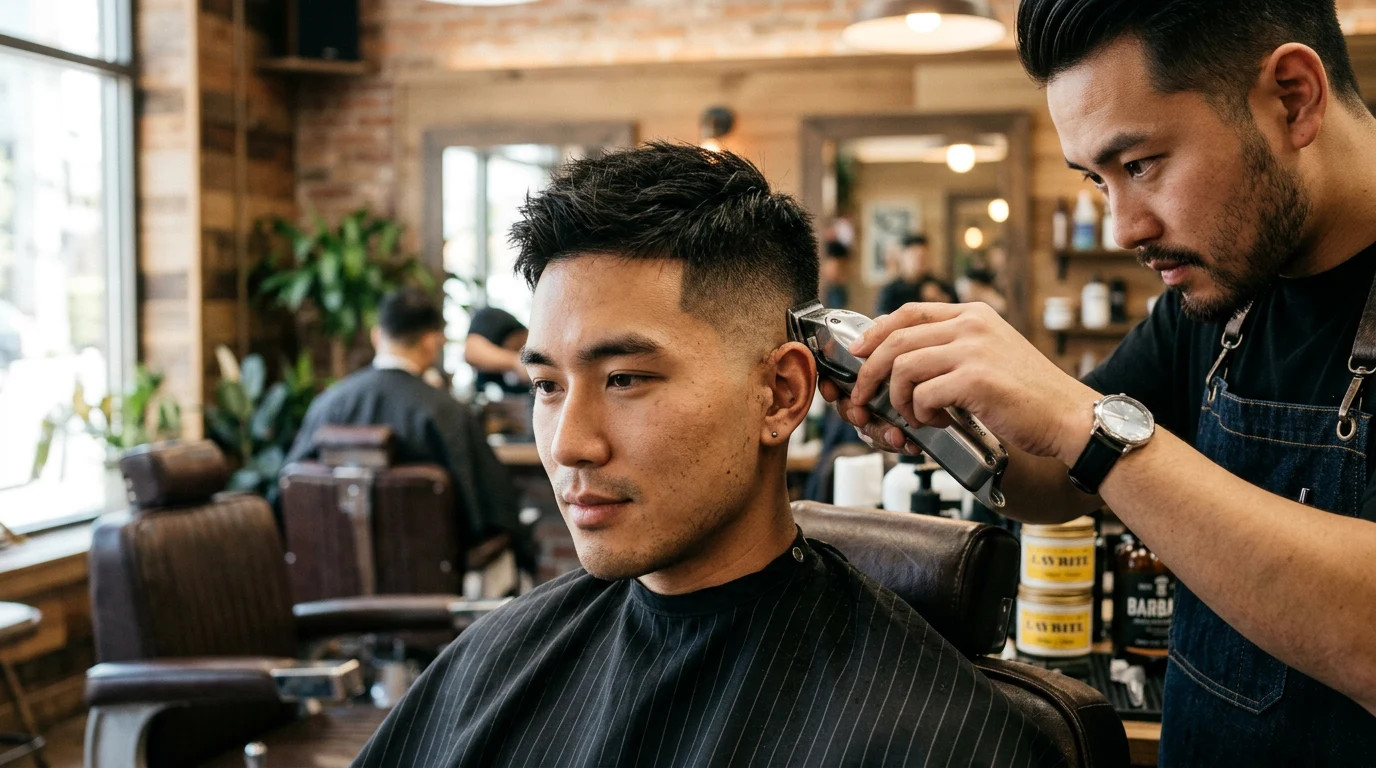
- Do not fight the cowlick: Cutting against it just makes it more visible. Cut with the growth direction.
- Leave length over cowlicks: More weight means the hair falls over the whorl instead of spiraling out from it.
- Blow dry into shape: A blast of heat while pulling the hair in the desired direction can temporarily override the growth pattern.
- Accept imperfection: Even professional barbers cannot eliminate a strong cowlick. The goal is management, not elimination.

Thinning Dense Hair Without Losing Shape
Thinning is the most important technique for Asian hair that is not discussed enough. Without thinning, thick straight hair looks heavy, helmet-like, and difficult to style. With proper thinning, it gains movement, texture, and the ability to hold a shape.
- Never thin the very top layer: This creates visible holes. Start thinning from the second layer down.
- Thin vertically, not horizontally: Hold the thinning shears vertically and close them once per section, moving from mid-shaft to ends.
- Check as you go: After every few sections, let the hair fall naturally and assess whether more thinning is needed. Over-thinning is worse than under-thinning.
- Concentrate on the heaviest areas: The sides just above the ears and the crown area tend to have the most density. Focus thinning there.
A Structured Learning Path
The techniques covered here are learnable through practice, but if you want a structured, video-guided approach that takes you from complete beginner to confident home barber, the Home Haircutting Mastery course provides step-by-step systems for every skill level. It covers everything from basic clipper handling to advanced fades and includes a 7-day confidence guarantee.
Frequently Asked Questions
Why does Asian men’s hair stick up after cutting?
Asian hair follicles are typically round and thick, producing coarse strands that grow straight out from the scalp at a perpendicular angle. When cut short (especially on the sides), the hair lacks the weight to lay flat and stands upright. This is not a flaw in the cut. It is a characteristic of the hair type. Leaving the sides slightly longer (guard #3 or above) or using a texturizing technique prevents the “porcupine” effect.
Should I cut Asian hair wet or dry?
For clipper work on the sides and back, dry is fine. For scissors work on the top, damp hair is generally easier to control because it lays flatter and you can see the shape more clearly. Thick Asian hair does not shrink when dry like curly hair, so the wet-to-dry length difference is minimal.
What is the best haircut for thick Asian hair?
The two-block cut (disconnected undercut with textured top) is extremely popular because it works with thick hair’s natural volume. Other strong options include the textured fringe, soft taper, and layered middle part. All of these use the natural density as an advantage rather than fighting it. See our soft taper for Asian men guide for one of the most versatile options.
How do I thin out thick Asian hair on top?
Thinning shears are the primary tool. Take vertical sections of hair, slide the thinning shears in about 2 inches from the ends, and close them once. This removes bulk without changing the visible length. Point-cutting with regular scissors also reduces weight. Never thin the very top layer, as it can create visible holes.
Can I do a two-block cut at home?
Yes. The two-block is actually one of the simpler structured cuts because the disconnection between top and sides means you do not need to blend a gradient. Clipper the sides to your desired short length, leave the top long, and the contrast does the work. The challenge is in texturizing the top, which requires scissors and some practice with point-cutting.
The Bottom Line
Asian men’s hair is thick, strong, and capable of holding structured styles that thinner textures cannot achieve. The key is understanding what the hair wants to do naturally and working with it: keep sides at a manageable length, thin aggressively to remove bulk, texturize the top for movement, and use heat styling to train direction. Once you learn to work with the natural characteristics instead of fighting them, home cuts become straightforward and the results can be exceptional.