
Last updated: February 2026 by Jaylen Torres, Curl Specialist & Trichology Educator
I spent the first 18 years of my life fighting my curls. Buzz cuts, flat irons, that phase where I soaked my hair in drugstore gel until it looked like a helmet. Growing up mixed in Miami, nobody handed me a manual for 3B curls. My barber said keep it short. My abuela said put coconut oil on everything. My friends with straight hair said “just use shampoo, bro.” None of that worked because none of it was a routine. It was guessing.
A curly hair routine for men is not about owning 14 products or spending an hour in the bathroom. It is about understanding what your curl type needs, giving it those things consistently, and then not touching it. That last part is the hardest. This guide breaks down routines by curl type from loose 2A waves through tight 4A coils, with exact product amounts, step timing, and the techniques that actually matter for shorter men’s hair. For expert guidance on this topic, consult the American Academy of Dermatology’s curly hair guide.
Whether you rock a curly hair fade or grow your curls out to medium length, the fundamentals are the same. Let me show you what actually works.
Why a Routine Matters More Than Products
Here is the truth that product companies do not want you to hear: consistency beats ingredients. I have seen guys with $8 worth of products and a solid routine have better curls than guys with $80 worth of premium creams and zero structure. Your curls respond to patterns. When you cleanse, condition, and style in the same order, with the same timing, your hair learns what to expect. The curl clumps form more reliably. Frizz decreases. Definition increases.

The guys who bounce between products every week and wash whenever they feel like it are the same guys posting on Reddit asking why their curls look different every day. It is not the products. It is the lack of system.
That said, you do need to match your routine complexity to your curl type. A guy with 2A waves does not need the same steps as a guy with 3C coils. More texture means more steps, more moisture, and more intentional drying. Here is how it breaks down.
Know Your Curl Type First
Before you build a routine, you need to know your curl type. Wash your hair with a gentle shampoo, skip every product, and let it air dry completely. What forms naturally is your baseline pattern. Do not judge your curls on a humid day or after sleeping on them weird. Clean, product-free, air-dried hair tells the truth.
| Curl Type | What You See | Routine Complexity | Key Product Need |
|---|---|---|---|
| 2A-2B (Wavy) | Loose S-shaped waves, minimal volume | Simple (3 steps) | Lightweight hold |
| 2C (Wavy-Curly) | Defined waves with spiral sections | Simple-Medium (3-4 steps) | Light moisture + hold |
| 3A (Curly) | Loose springy curls, sidewalk chalk diameter | Medium (4 steps) | Moisture + definition |
| 3B (Curly) | Tighter springy curls, more volume and shrinkage | Medium (4-5 steps) | Moisture + strong hold |
| 3C-4A (Curly-Coily) | Tight corkscrews to S-shaped coils | Full (5 steps) | Heavy moisture + sealing |
Reality check: most guys are not one uniform type. I have 3B at the crown, 3C near the nape, and something close to 3A at the temples. Mixed-texture hair is normal, especially for biracial men. Build your routine for your dominant curl type and adjust product amounts in specific areas. For a deep dive into curl pattern science, check out our curl definition guide.
The Five Foundation Rules for Every Curl Type
These rules apply whether you are 2A or 4A. They are non-negotiable.
Rule 1: Sulfate-Free Cleansing
Traditional shampoos contain sodium lauryl sulfate and sodium laureth sulfate. These are aggressive detergents that strip every bit of natural oil from your hair and scalp. For curly hair, natural oil is not the enemy. It is what keeps your curls soft, defined, and frizz-free. Sulfate-free shampoos clean without stripping. The SheaMoisture Coconut & Hibiscus Shampoo is my baseline recommendation because it cleanses effectively without leaving that squeaky-clean feeling that curly hair hates.
Rule 2: Condition Every Single Wash
Conditioner is not optional and it is not “just for women.” It replaces moisture, smooths the cuticle layer so curls clump together instead of frizzing apart, and provides slip for detangling. Skip conditioner and you are fighting physics. Curly hair has a twisted structure that makes it harder for natural oils to travel from root to tip compared to straight hair. Conditioner fills that gap.
Rule 3: Apply Everything to Soaking Wet Hair
Not damp. Not towel-dried. Soaking wet, with water dripping. Water is your first styling product. It helps distribute leave-ins and stylers evenly, reduces friction between strands, and encourages curl clumps to form. The second you towel-dry before applying product, you are introducing frizz. Apply your leave-in and styler in the shower with the water off, then carefully exit and dry.
Rule 4: Never Brush or Comb Dry Curls
Brushing dry curly hair separates curl clumps and creates a frizz explosion. Only detangle when your hair is wet and saturated with conditioner, using a wide-tooth comb or your fingers. Work from tips to roots, never the other way around. If you have been raking a fine-tooth comb through dry curls, that alone explains half your frizz.
Rule 5: Do Not Touch Your Hair While It Dries
Once you apply your products and begin drying (air dry, diffuse, or plop), keep your hands off. Every time you touch drying curls, you disrupt the curl clumps and introduce frizz. This is the hardest rule for guys because we are used to running hands through our hair all day. Stop. Let the gel cast form, let the curls set, and only touch them once they are 100% dry. Mastering curly hair routine for men takes practice but delivers great results.
Routine for Type 2 Waves (2A, 2B, 2C)
Wavy hair is the lowest-maintenance curl type, but it is also the easiest to weigh down with too much product. The goal here is enhancing your natural wave pattern without flattening it.
Wash Day (2-3 Times Per Week)
| Step | What to Do | Product Amount | Time |
|---|---|---|---|
| 1. Cleanse | Sulfate-free shampoo, focus on scalp only | Quarter-sized | 2 min |
| 2. Condition | Lightweight conditioner, mid-lengths to ends | Dime-sized | 2 min (rinse after 1 min) |
| 3. Style | Light gel or mousse on soaking wet hair, scrunch upward | Dime-sized | 1 min |
Drying: Air dry or diffuse on low heat. For type 2 waves, air drying works well because the looser pattern does not need as much encouragement to form. If you diffuse, use the lowest heat setting and cup your waves upward with the diffuser bowl.
Product notes: Skip curl creams and leave-ins for 2A-2B. They are too heavy and will pull your waves flat. A light gel like Eco Styler Olive Oil Gel gives hold without weight. Type 2C can handle a small amount of lightweight leave-in if frizz is an issue.

Refresh Day
Spray hair lightly with water. If waves have lost shape, add a tiny amount of gel to wet hands and scrunch. Do not oversaturate. Wavy hair refreshes easily because the pattern is looser and reforms quickly with minimal intervention.
Routine for Type 3A-3B Curls
This is the sweet spot for most guys searching for a curly hair routine. Types 3A and 3B are springy, visible curls that respond dramatically to the right technique. Get the routine right and these curls look incredible. Get it wrong and it is frizz city.
Wash Day (2 Times Per Week)
| Step | What to Do | Product Amount | Time |
|---|---|---|---|
| 1. Cleanse | Sulfate-free shampoo on scalp, let suds run through lengths | Quarter-sized | 2 min |
| 2. Condition + Detangle | Apply conditioner generously, detangle with wide-tooth comb tips to roots | Nickel-sized | 3-4 min |
| 3. Leave-In | Apply to soaking wet hair using praying hands method | Pea-sized | 1 min |
| 4. Style | Curl cream or gel, scrunch upward to encourage clumps | Dime to nickel-sized | 2 min |
The praying hands method: Rub product between your palms, then sandwich a section of hair between your flat palms and slide down. This distributes product evenly without disrupting curl clumps. Follow with scrunching (cupping hair upward toward your scalp) to encourage definition.
Product picks: Aunt Jackie’s Leave-In Conditioner as the leave-in, followed by SheaMoisture Curl Enhancing Smoothie as the styler. This combination provides moisture and medium hold without heaviness. For a complete product breakdown, see our best curly hair products guide.
Drying: Diffusing is ideal for 3A-3B. It speeds up drying while encouraging volume and definition. Plop in a microfiber towel for 10-15 minutes first, then diffuse on medium heat. Never rub with a regular towel. The friction destroys curl clumps. Our diffusing guide covers the full technique.
Refresh Day
Spray generously with water (50/50 water and leave-in conditioner mix works even better). Scrunch to reactivate the product already in your hair. Add a small amount of gel to any sections that lost definition. Avoid rewetting your entire head. Target the problem areas only.
Routine for Type 3C-4A Curls
Tighter curls mean more shrinkage, more dryness, and more need for sealing moisture in. This is where the routine gets the most steps, but each step earns its place. If you are mixed-race with 3C-4A curls, this section is especially relevant. Check our mixed race hair care guide for additional cultural context.
Wash Day (1-2 Times Per Week)
| Step | What to Do | Product Amount | Time |
|---|---|---|---|
| 1. Pre-Poo (optional) | Apply coconut oil to dry hair 30 min before washing | Nickel-sized | 30 min pre-wash |
| 2. Cleanse | Gentle shampoo or co-wash on scalp, massage thoroughly | Quarter-sized | 3 min |
| 3. Deep Condition | Heavy conditioner, detangle section by section with wide-tooth comb | Quarter-sized | 5-10 min (leave on) |
| 4. Leave-In | Apply to soaking wet hair, praying hands then finger coil problem areas | Nickel-sized | 2 min |
| 5. Seal + Style | Layer cream then gel (the “super soaker” method: scrunch water-product-water) | Nickel cream + nickel gel | 3 min |
The pre-poo: For 3C-4A curls, applying oil to dry hair before shampooing prevents the cleanser from stripping too much moisture. Coconut oil penetrates the hair shaft (unlike most oils that only coat). Apply 30 minutes before your shower, or even the night before if your hair is extremely dry.
Finger coiling: After applying leave-in, take individual curl clumps and wrap them around your finger in the direction they naturally spiral. Release gently. This trains tighter curls into more uniform coils and dramatically improves definition. It takes practice, but once you get the motion down, you can coil your whole head in under 5 minutes.
Product picks: Mielle Pomegranate Honey Shampoo for cleansing (gentle enough for tight curls), Aunt Jackie’s Leave-In for moisture, and Eco Styler Olive Oil Gel layered on top to seal everything in. The gel cast is your best friend with this curl type.
Drying: Plop for 15-20 minutes, then either air dry or diffuse. Tight curls take longer to dry, so plan accordingly. Air drying can take 2-4 hours depending on length and density. Diffusing cuts that to 30-45 minutes. Never go to bed with wet hair in this curl range. The compression from your pillow will flatten one side and create asymmetric curls.
Refresh Day
Spray generously with a water and leave-in mix. Finger coil any sections that lost definition. Add a light layer of gel on top and let air dry. Tighter curls are harder to refresh than looser ones because the clumps do not reform as easily once disrupted. Sleeping on a satin pillowcase or using a satin bonnet dramatically reduces the need for refresh product. Understanding curly hair routine for men is key to a great grooming routine.
Wash Day Schedule by Curl Type
| Curl Type | Shampoo Frequency | Co-Wash Days | Clarify Frequency | Total Wet Days/Week |
|---|---|---|---|---|
| 2A-2B | Every 2-3 days | Optional | Every 2 weeks | 3-4 |
| 2C | Every 3 days | 1x between shampoos | Every 2 weeks | 3 |
| 3A | 2x per week | 1x between shampoos | Every 3-4 weeks | 3 |
| 3B | 2x per week | 1x optional | Monthly | 2-3 |
| 3C-4A | 1-2x per week | 1x between shampoos | Monthly | 2-3 |
What is clarifying? Even sulfate-free shampoos leave trace residue. Over time, product buildup dulls your curls and makes them less responsive to styling. A clarifying shampoo (one with gentle sulfates or apple cider vinegar) strips that buildup once or twice a month. Your curls will feel “reset” after clarifying. Do not skip this step.
Drying Methods Ranked
How you dry your hair matters as much as what you put in it. Here is every method, ranked by curl type suitability.
| Method | How It Works | Best For | Frizz Risk | Time |
|---|---|---|---|---|
| Air Dry | Do nothing, let hair dry naturally | 2A-3A, short hair | Low | 1-3 hours |
| Plopping | Lay hair onto a microfiber towel or t-shirt, wrap | All types | Very low | 15-30 min + air dry |
| Diffusing | Blow dryer with diffuser attachment, low-medium heat | 3A-4A, medium length | Low-medium | 15-30 min |
| Microfiber Towel | Scrunch dry with microfiber (not terrycloth) | All types | Low | 5 min + air dry |
| Towel Dry (regular) | Rub with cotton towel | Nobody | Extreme | 5 min |
Never use a regular cotton towel. The rough texture of terrycloth catches on curl clumps, rips them apart, and creates frizz. A microfiber towel or an old cotton t-shirt has a smoother surface that absorbs water without disrupting your curls. This single switch can cut your frizz by 40-50%.

Styling Techniques That Actually Work for Short-Medium Hair
Most curl styling tutorials are designed for women with shoulder-length or longer hair. The techniques need adjustment for men’s typical 2-6 inch length.
Scrunching
Cup your hair from the ends upward toward your scalp. Think of it as squeezing a sponge in reverse. This encourages curl clumps to form and pushes product into the hair shaft. For short hair (under 3 inches), scrunch at the temples and crown rather than grabbing lengths. Works for all curl types.
Praying Hands
Place product on your palms, sandwich a section of hair between flat palms, and glide downward. This distributes product evenly without breaking up clumps. Best for applying leave-in and cream to types 3A and tighter. For men’s shorter hair, use small sections and start at the crown.
Finger Coiling
Wrap individual curl clumps around your index finger in the direction they naturally spiral. Release without pulling. This is the most time-intensive technique but delivers the most definition for 3C-4A curls. On short hair, you only need to coil the top and crown since the sides are usually faded.
Scrunch Out the Crunch (SOTC)
After your gel cast forms and your hair is 100% dry, scrunch your hair gently to break the cast. Your curls will go from crunchy and hard to soft and defined while keeping the shape the gel created. This is the finishing move. Do it too early (before fully dry) and you get frizz. Do it at the right time and your curls look natural, soft, and perfectly defined. Apply a drop of oil to your palms before scrunching for extra shine.
How Porosity Changes Your Routine
Curl type tells you what your hair looks like. Porosity tells you what your hair needs. Two guys with 3B curls can need completely different products if one has low porosity and the other has high. Read our complete hair porosity guide for the full breakdown, but here is the cheat sheet.
| Porosity | What It Means | Routine Adjustment |
|---|---|---|
| Low Porosity | Cuticles are tightly packed, hair repels moisture | Use lightweight products, apply to very warm/hot wet hair to open cuticles, avoid heavy butters |
| Medium Porosity | Balanced moisture absorption | Standard routine works, most products perform well |
| High Porosity | Cuticles are raised/damaged, hair absorbs and loses moisture quickly | Use heavier leave-ins and seal with oil or butter, deep condition weekly, protein treatments monthly |
Quick porosity test: Drop a clean hair strand into a glass of room-temperature water. Wait 2-4 minutes. If it floats, you have low porosity. If it sinks slowly, medium. If it drops to the bottom quickly, high porosity. This test is not 100% scientific, but it gives you a useful starting point for product selection.
Sample Weekly Schedule
Here is what a practical weekly routine looks like for a guy with 3B curls. Adjust the frequency based on your curl type using the wash schedule table above.
| Day | Action | Products Used | Time |
|---|---|---|---|
| Monday | Wash Day | Shampoo, conditioner, leave-in, gel | 15 min + dry time |
| Tuesday | Refresh | Water spray, small gel touch-up | 3 min |
| Wednesday | Refresh | Water spray, leave-in mist | 3 min |
| Thursday | Wash Day | Co-wash, leave-in, gel | 12 min + dry time |
| Friday | Refresh | Water spray, gel touch-up | 3 min |
| Saturday | Refresh or rest | Minimal or none | 0-3 min |
| Sunday | Deep Condition (bi-weekly) | Shampoo, deep conditioner, full style | 25 min + dry time |
Total weekly time: About 60-75 minutes including drying. Compare that to the time you spend fighting frizz and restyling flat curls every morning without a routine. The routine saves time over a full week, not just on wash day.
Product Amount Guide
The biggest mistake men make with curl products is using too much. Women’s tutorials assume 12-18 inches of hair. You have 3-6 inches. Here is the conversion chart.
| Hair Length | Leave-In | Curl Cream | Gel |
|---|---|---|---|
| Buzz to 1 inch | Skip | Pea-sized | Pea-sized |
| 1-3 inches | Pea-sized | Pea to dime | Dime-sized |
| 3-5 inches | Dime-sized | Dime-sized | Nickel-sized |
| 5-8 inches | Nickel-sized | Nickel-sized | Quarter-sized |
| 8+ inches | Nickel to quarter | Quarter-sized | Quarter to half-dollar |
Start with less than you think you need. You can always add more. You cannot remove product without rewashing. If your curls feel crunchy or stiff after drying, you used too much gel. If they are limp and undefined, you used too little or your product is too lightweight for your curl type.
10 Mistakes That Kill Your Curly Hair Routine
I have made every one of these. Learn from my suffering. When it comes to curly hair routine for men, technique matters most.
- Using regular shampoo. Sulfates strip your curls. Switch to sulfate-free immediately. The tgin Moisture Rich Shampoo is a solid affordable option.
- Applying product to damp or dry hair. Soaking wet or nothing. Water is the vehicle that distributes product evenly.
- Rubbing with a terrycloth towel. Microfiber towel or old t-shirt only. Terrycloth is curl destruction.
- Touching hair while drying. Hands off until 100% dry. Every touch equals frizz.
- Skipping conditioner. You need it every single wash. No exceptions.
- Using too much product. More is not more. Overloading short hair creates buildup and crunch.
- Brushing dry curls. Detangle wet with conditioner in, using a wide-tooth comb, tips to roots.
- Changing products every week. Give a product 3-4 weeks before judging. Your hair needs time to adjust.
- Sleeping on cotton pillowcases. Cotton absorbs moisture and creates friction. Switch to satin or silk.
- Never clarifying. Product buildup dulls curls over time. Clarify monthly to reset.
Results Timeline: What to Expect
| Timeline | What Happens |
|---|---|
| Day 1 | Immediate improvement in definition and moisture. Curls clump better than they ever have. |
| Week 1 | Adjustment period. Your hair may feel different (waxy, too soft, unpredictable) as it transitions off sulfates. |
| Week 2-3 | Hair starts responding consistently. Curl pattern becomes more predictable. Frizz decreases noticeably. |
| Week 4-6 | Hair is fully transitioned. Products perform reliably. You know your exact amounts and technique. |
| Month 2-3 | Curl pattern may actually change as hair recovers from past damage. Curls can become tighter and more defined. |
The transition period is real. Weeks 1-2 feel worse before they feel better, especially if you are coming off years of sulfate shampoo and silicone products. Your hair needs to purge the silicone buildup and relearn how to produce and retain its own moisture. Stick with the routine. The payoff at week 4 is worth the awkward period.
Adapting Your Routine for a Curly Fade
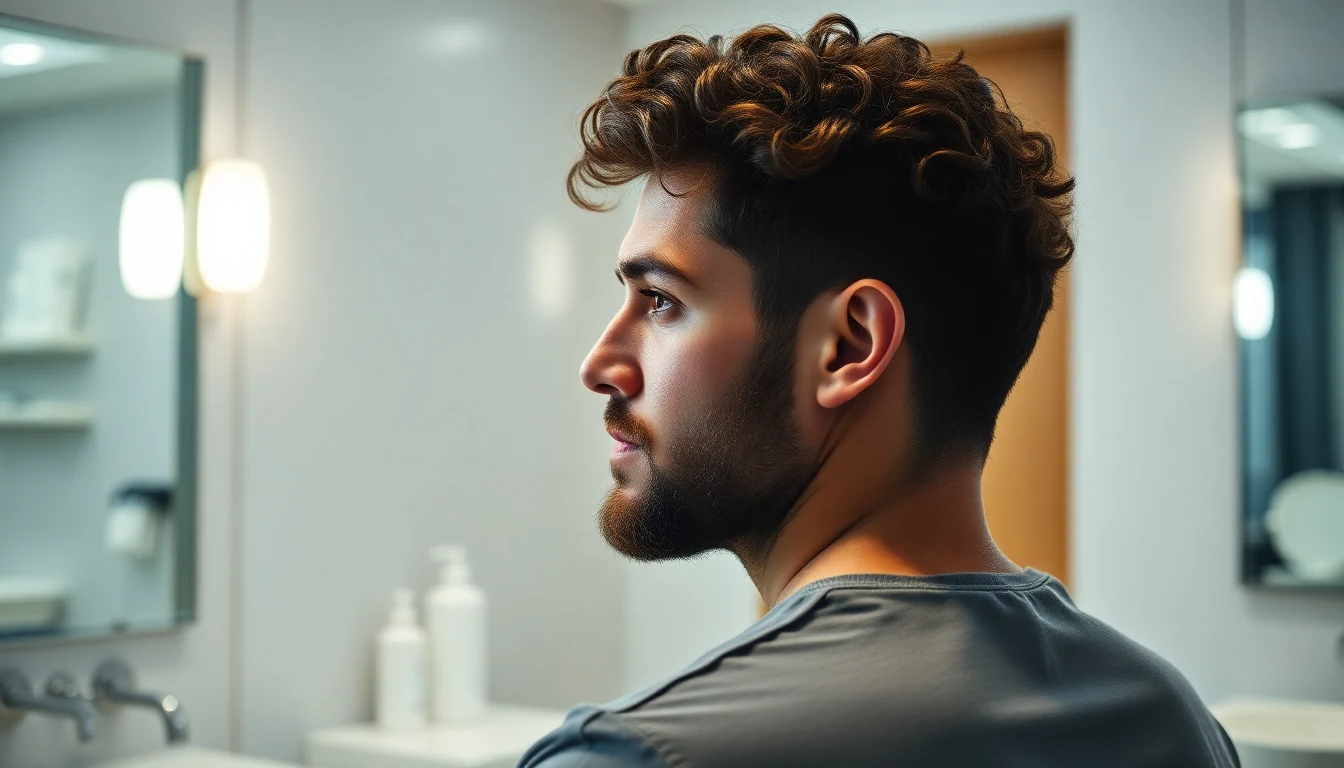
Most guys with curly hair rock some version of a fade. That means the sides and back are too short for curl products while the top needs the full routine. Here is how to handle it.
Product application zone: Only apply leave-in, cream, and gel to the top section where you have enough length for curls to form (usually 2+ inches). The faded sides get whatever runs down from the top during rinsing, which is fine.
Shampoo the whole head. Your scalp needs cleansing everywhere, not just on top. Massage the shampoo into your faded sides and back too.
Conditioner from the ears up. Focus conditioner on the longer curly section. The faded areas do not need it and adding conditioner there just makes them look greasy.
For specific fade style recommendations, check our curly hair fade guide and our curly hair fade styles breakdown.
Budget Routine: Under $25
You do not need expensive products to have a solid curl routine. Here is a complete setup for under $25 that works for types 2C through 3C.
| Product | Role | Approximate Price |
|---|---|---|
| tgin Moisture Rich Shampoo | Cleanser | $10 |
| Aunt Jackie’s Leave-In | Leave-in + detangler | $8 |
| Eco Styler Olive Oil Gel | Styler + hold | $5 |
Three products, under $25 total, and each one lasts 4-8 weeks for men’s hair lengths. You do not need the $38 curl cream from the boutique brand. You need the right products used consistently with the right technique. Technique beats price every time.
Nighttime Routine: Protect While You Sleep
Eight hours on a cotton pillowcase will undo your entire wash day. Your curls get compressed, moisture gets absorbed into the fabric, and you wake up with flat, frizzy hair on one side. Here are your options, ranked.
- Satin/silk pillowcase (easiest): Swap your cotton pillowcase for satin. Your curls glide instead of catching. This alone extends your style by 1-2 extra days. Cost: $10-15.
- Satin bonnet or buff: More protection than a pillowcase because it contains your curls completely. Best for 3C-4A curls that lose definition overnight. Takes some getting used to.
- Pineapple method: Gather curls into a loose, high ponytail at the top of your head (if long enough). This prevents compression on the sides and back. Works for 3+ inches of length.
Frequently Asked Questions
How often should men with curly hair wash their hair?
Most men with curly hair should wash two to three times per week with a sulfate-free shampoo. Daily washing strips the natural oils that keep curls moisturized and defined. If your scalp gets oily between washes, use a co-wash or rinse with just water and conditioner. Type 2 waves can handle washing every other day, while types 3B and tighter often do better with twice a week.
What is the basic curly hair routine for men?
A basic curly hair routine has four steps: cleanse with a sulfate-free shampoo, condition and detangle, apply a leave-in conditioner to soaking wet hair, and finish with a styler (gel or cream depending on curl type). The entire routine takes 10 to 15 minutes on wash day and 3 to 5 minutes on refresh days. Start with three products maximum and add only if needed.
Should men with curly hair use conditioner every wash?
Yes, always. Conditioner is not optional for curly hair. It replaces the moisture that shampooing removes, makes detangling possible without breakage, and helps curl clumps form. Even on shampoo-free days, running a conditioner through your hair (co-washing) keeps curls soft and defined. Skip conditioner and your curls will be dry, frizzy, and harder to manage.
How long does it take to see results from a curly hair routine?
Expect noticeable improvement within two to three weeks of consistent routine. The first wash will show some definition, but your hair needs time to recover from previous damage and product buildup. By week four, your curl pattern will be more consistent. Full results, where your hair responds predictably to products, usually take six to eight weeks of following the same routine.
Can men with short curly hair still follow a curl routine?
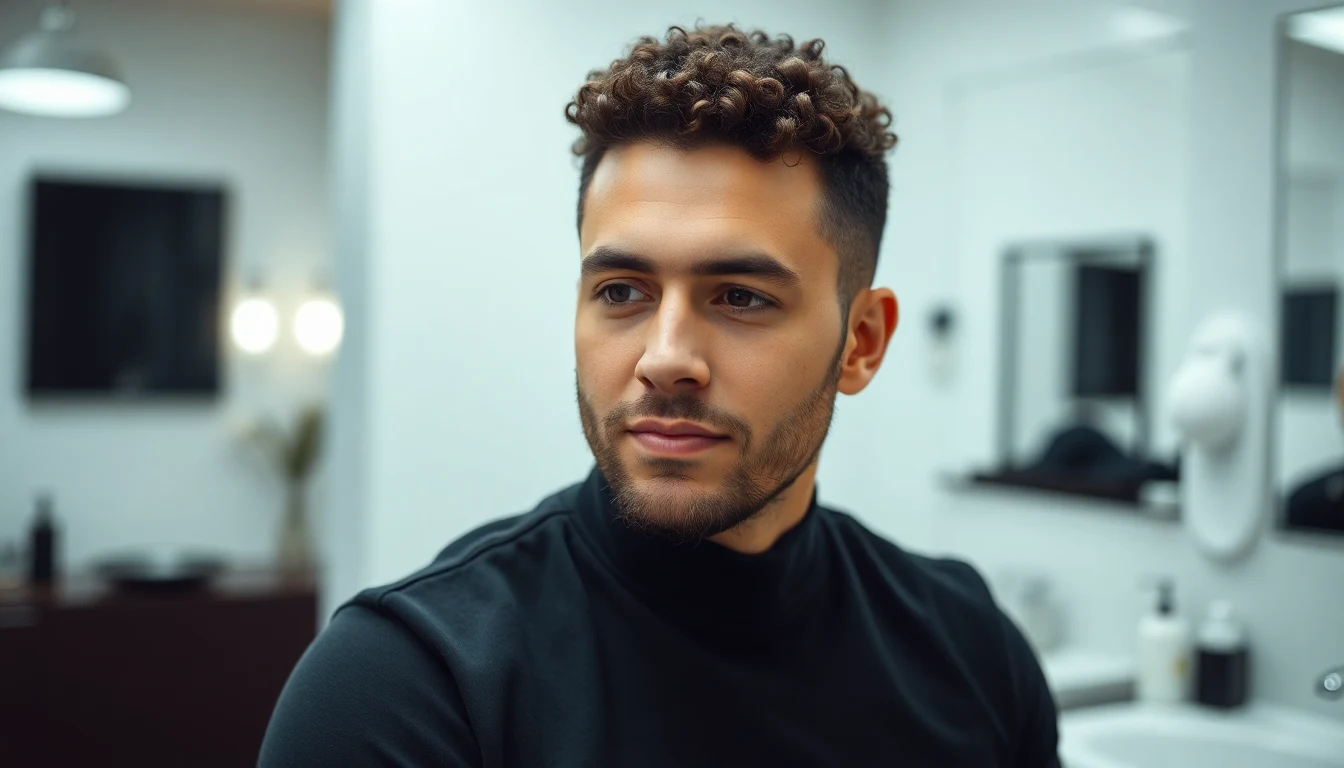
Absolutely, and short curly hair is actually easier to manage with a routine. The key adjustment is using less product. A dime-sized amount of curl cream covers a 3-inch fade. Short curls also dry faster, so air drying becomes practical. The same principles apply: sulfate-free cleansing, conditioning every wash, applying product to wet hair, and not touching your curls while they dry.
Frequently Asked Questions
How often should I wash my curly hair if I have type 3B curls?
Type 3B curls typically need washing 2 times per week to maintain moisture and definition without over-stripping natural oils. The guide provides specific wash day and refresh day routines tailored to your curl pattern so you can keep your curls healthy between washes.
What’s the most important rule for a curly hair routine for men?
The most important rule is applying all products to soaking wet hair, as this helps your curls absorb moisture and maintain their shape. Combined with sulfate-free cleansing and consistent conditioning, this foundation rule applies to all curl types from waves to coils.
Can I use a regular brush or comb on my curls?
No, you should never brush or comb dry curls as this causes frizz, breakage, and destroys your curl pattern. If you need to detangle, do it on soaking wet hair with conditioner as a slip agent to protect your curls.
Do I really need 14 different products for curly hair?
No, a proper curly hair routine is about understanding what your specific curl type needs and using the right products consistently, not accumulating numerous bottles. The guide shows you the five foundation rules and exact product amounts that actually matter for shorter men’s hair.