
Last updated: March 2026 by Marcus Chen-Williams, Founder & Editor
Cutting your child’s hair at home saves money, eliminates the scheduling headache, and can become a bonding routine that both parent and child enjoy. But it also involves a challenge that adult haircuts do not: managing a small person who may not want to sit still, may be afraid of buzzing sounds near their ears, and has zero patience for precision.
This guide covers both the technique and the psychology. The cutting itself is simpler than an adult haircut. The child management is where most parents actually struggle.
For adult haircutting techniques and general tool setup, see our complete home haircutting guide.
The Real Challenge: Child Management
Technical skill means nothing if the child will not cooperate. Before discussing guard lengths and blending, let us address what actually determines success or failure.
Desensitization (Before the First Cut)
Children fear what they do not understand. The buzz of clippers near their head is loud, unfamiliar, and vibrating. Desensitize before you ever attempt a cut:
- Let them hold the clippers (turned off) and examine them
- Turn the clippers on and let them feel the vibration on their hand or arm
- Run the clippers near (not on) their head so they hear the sound
- Let them “cut” a stuffed animal’s hair or watch you cut your own
- Do this over multiple days if needed. Rushing creates lasting aversion.
Timing
- After a meal: Hungry children have zero patience
- Not before bed: Tired children are irritable children
- Mid-morning or early afternoon: Most children’s peak cooperation window
- Never right after an upsetting event: Start from a calm baseline
Distraction
Screen time is your ally during haircuts. A tablet propped at eye level with their favorite show buys you 15-20 minutes of relative stillness. Other options: a lollipop (keeps the head pointed down), a small toy, or conversation about something they are excited about.
Positioning
- Ages 1-3: Sitting on a parent’s lap. One parent holds, one cuts.
- Ages 3-5: Booster seat or stool with a towel-covered back. Feet should touch something (dangling feet increase fidgeting).
- Ages 5+: Regular chair with a booster if needed. Head at your chest height.
Speed Over Perfection
A 15-minute good-enough cut is better than a 40-minute perfect cut that traumatizes the child. Get the major areas done first (sides, top), then do detail work (neckline, around ears) if cooperation holds. If the child is done, stop. You can always touch up later.
Age-Appropriate Styles
| Age | Best Styles | Why |
|---|---|---|
| 1-2 | Simple trim with scissors | Too young for clippers in most cases. Just shape and even out. |
| 3-4 | Uniform buzz (#3 or #4 all over) | Fast, requires minimal cooperation. One guard, done. |
| 5-7 | Short sides, longer top (basic) | Two guard sizes, simple blend. Looks intentional. |
| 8-10 | Low fade, textured top | Child can sit long enough. Starting to care about appearance. |
| 11+ | Any adult style adapted | Full cooperation possible. Can handle fades, lineups, styled tops. |
Step-by-Step: The Basic Kids’ Cut
This is the workhorse cut for boys ages 3-8. Shorter sides, slightly longer top. Clean, easy, and fast.
Step 1: Prep (2 minutes)
- Set up distraction (tablet, show, snack)
- Cape or towel around shoulders
- Oil clipper blades
- Have both guards ready (sides guard + top guard)
Step 2: Sides (#2 or #3 guard, 3-4 minutes)
- Start at the sideburn and move upward
- Go all the way around: both sides, behind ears, back of head
- Stop where you want the top to begin (usually at the temples)
- Work quickly and confidently. Hesitation prolongs the process.
Step 3: Top (#5 or #6 guard, 3-4 minutes)
- Switch to the longer guard
- Run front to back across the top
- Overlap passes to avoid missed strips
- The top does not need to be perfect. Texture and natural growth hide minor inconsistencies.
Step 4: Quick Blend (2-3 minutes)
- Use the guard between your sides and top (e.g., #4 if sides are #3 and top is #5)
- Focus only on the line where the two lengths meet
- A few quick flicking passes is enough for a child’s cut. Do not obsess over a perfect gradient.
Step 5: Neckline and Ears (2 minutes)
- Trimmer or clipper without guard for the neckline
- Gentle curve across the back, using the natural hairline as a guide
- Carefully around the ears (fold the ear down with your free hand)
- This is often when children get restless. Be quick and gentle.
Total time: 12-15 minutes. With practice, this drops to under 10.
Handling Hair Texture Differences in Kids
Children’s hair varies as much as adults’. If your child has a specific hair texture, the adult guides apply with gentler technique:
- Coily / 4C hair: Cut dry, use slightly longer guards than planned, and see our Black men’s hair guide for texture-specific fade techniques (same principles, gentler approach)
- Thick straight hair (Asian): Use thinning shears on top if it is very dense. Keep sides at #3 or above to prevent sticking out.
- Thick wavy/straight hair (Latino): Follow the same basic cut but expect faster growth. Plan for more frequent trims. See our Latino hair guide for texture tips.
- Fine, thin hair: Use sharp blades. Dull blades pull fine hair, which is painful and scary for kids. Every imperfection is visible, so take a bit more care with blending.
First Haircut Milestones
Some cultures and traditions place significance on the first haircut. A few examples from the communities we cover at CulturedGrooming: For expert guidance on this topic, consult the American Academy of Dermatology’s skincare routine guide.
- Upsherin (Jewish tradition): First haircut at age 3. See our bar mitzvah grooming guide for cultural context.
- Aqiqah (Islamic tradition): Head shaving on the 7th day after birth, with the hair’s weight in silver given as charity.
- Chudakarana (Hindu tradition): First haircut ceremony, typically between ages 1-3.
- General: Many families simply wait until the hair needs it and treat it as a practical milestone rather than a ceremony.
Regardless of tradition, the first haircut sets the tone. Make it calm, quick, and positive. The child’s experience here shapes their attitude toward haircuts for years.
When Kids Start Caring About Their Hair
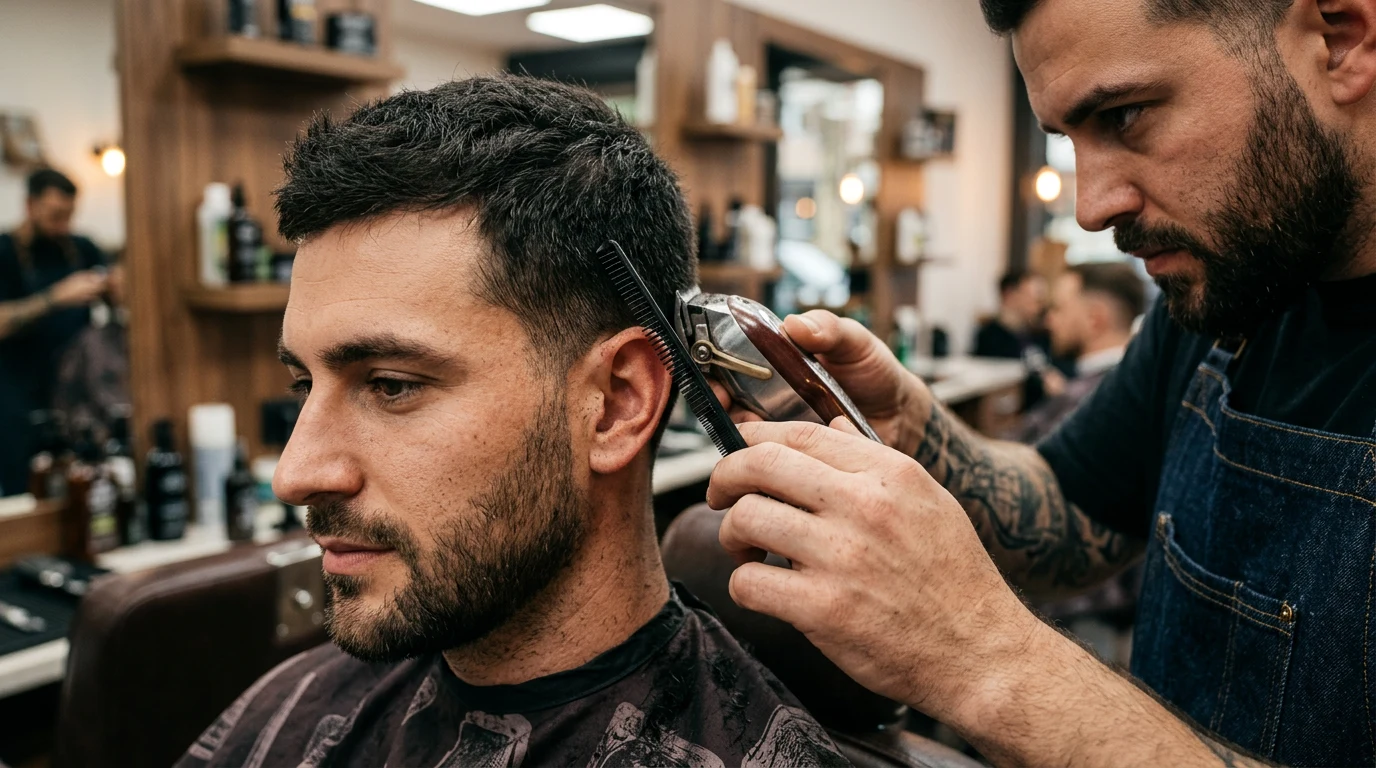
Around age 8-10, most children start expressing preferences. They want what their friends have, what they see on social media, or what their favorite athlete wears. This is actually an advantage for the home-cutting parent because now the child is motivated to sit still for a better result.
At this age, you can graduate to:
- Low or mid fades (the child can sit for the additional time)
- Longer styled tops (requires scissors work)
- Line-ups (older kids appreciate the clean look)
- Specific styles they request (show them a photo for reference)
A System Built for Parents
If you want a structured, step-by-step program specifically designed for parents cutting kids’ hair, the Home Haircutting Mastery course was built for exactly this situation. Created by a professional barber who grew up in a household of seven boys (and spent 15+ years cutting children’s hair), it covers not just technique but child management, positioning strategies, and confidence-building routines that reduce stress for both parent and child.
Three tiers are available ($199 Basic, $249 Standard, $450 Elite with 1-on-1 guidance), and all come with a 7-day confidence guarantee. The child management module alone addresses the biggest challenge most parents face.
Frequently Asked Questions
At what age can I start cutting my child’s hair at home?
Most parents start with simple trims around age 1 to 2, when hair first needs shaping. For clipper cuts, age 3 to 4 is when most children can sit still enough for a basic cut. By age 5 to 6, most kids can handle a full haircut including sides and top if the environment is comfortable and the process is predictable.
How do I keep my child calm during a haircut?
Three strategies work consistently. First, desensitize before cutting by letting them hear and feel the clippers running on their hand or arm. Second, use distraction like a tablet, favorite show, or small toy. Third, keep sessions short. A 15-minute decent cut beats a 40-minute perfect cut that ends in tears.
What if my child is afraid of clippers?
Start with scissors only. Scissors are quieter and less intimidating. Once the child is comfortable with the haircut routine and environment, gradually introduce clippers. Let them hold the clippers (turned off), then turn them on nearby without cutting, then use them briefly on a small section. Build tolerance over multiple sessions.
What is the easiest kids’ haircut to do at home?
A uniform buzz cut using one guard size is the simplest. Choose a #3 or #4 guard, run the clippers all over the head in every direction, and clean up the neckline and ears. No blending required. As you build confidence, graduate to a longer top with shorter sides (two different guard sizes with basic blending).
How often do kids need haircuts?
Growth rate varies by age and individual, but most children need a trim every 4 to 6 weeks. Boys with fades or short sides may need touch-ups every 2 to 3 weeks to keep the cut looking fresh. Girls with longer styles can go 6 to 8 weeks between trims.
Should I cut my child’s hair wet or dry?
For clipper cuts, dry hair is easier and faster. For scissors cuts (especially longer styles), damp hair is easier to control and section. Never cut a child’s hair soaking wet, as it sticks to their neck and face, which increases discomfort and resistance.
The Bottom Line
Cutting kids’ hair at home is more about managing the child than mastering the technique. The actual cut is simpler than an adult haircut. Start with a one-guard buzz cut to build your confidence, graduate to a two-guard cut with basic blending, and eventually work up to fades and styled tops as both you and your child become comfortable with the process. Make it routine, make it calm, and it becomes something both of you look forward to.